The Critical Role of Health and Well-Being in Student Learning
A Future Ready Guide for Supporting Students
Establishing systems to address student health and well-being is a critical component of today’s successful learning environments, and that requires significant, choreographed, and intentional effort. Each community, school, and student is unique, and therefore systems must address each student’s individual needs.
This guide will help you personalize your approach to keep student health and well-being at the core of your ongoing progress and planning.
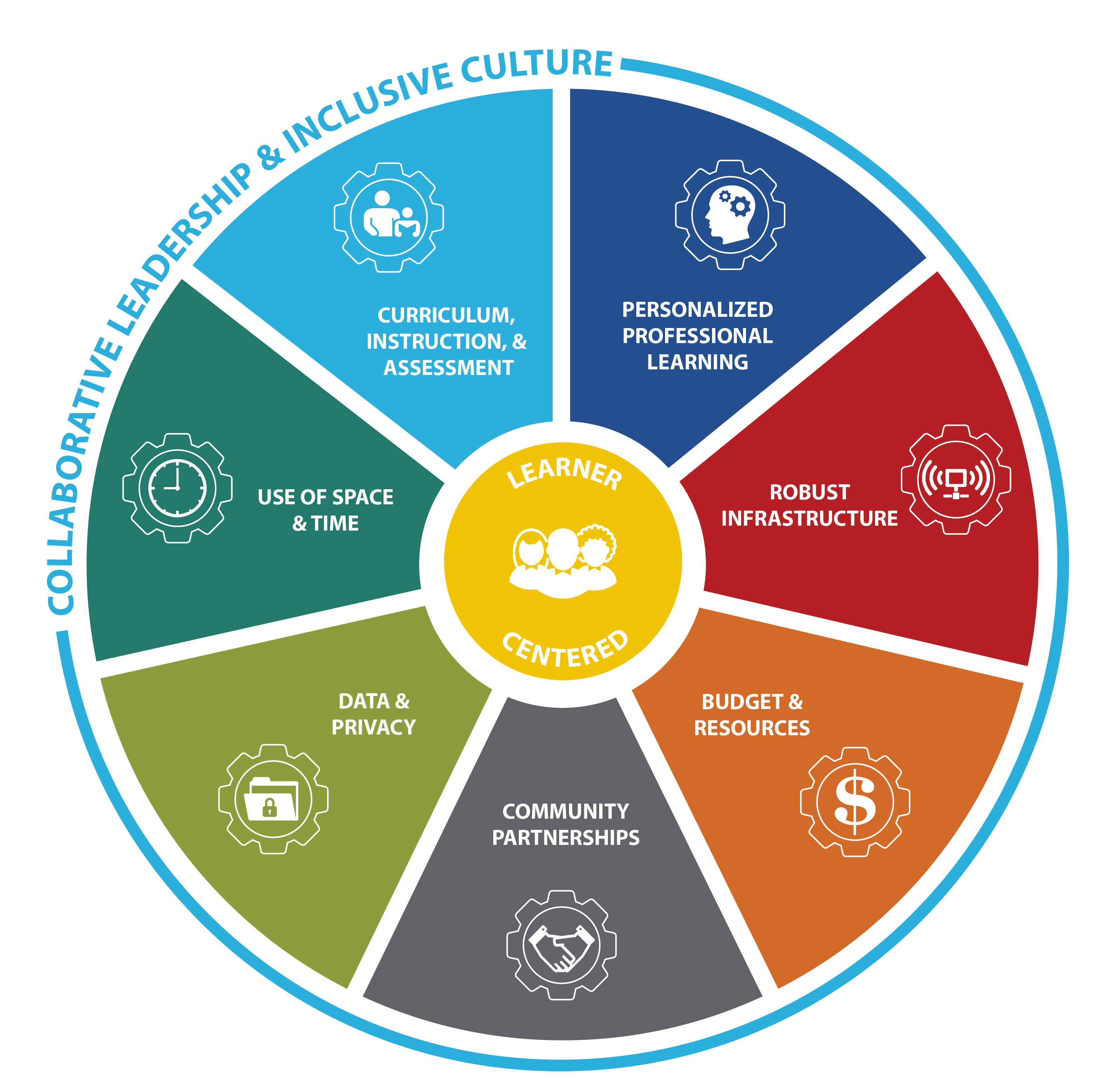
The Future Ready Framework is used as a road map to create a systemic approach to implementing a student health and well-being program across your school district. The framework keeps learners at the center, and encourages districts to address each of the seven key categories, called “gears,” in order to ensure fidelity of implementation on your transformation journey. You might also want to use the FRS SMART Goal guide to clearly define your needs, set measurable and empathetic goals, plan for equitable student success, reflect on desired outcomes, and celebrate team successes along the way.
For this guide we have embedded modern learning science into the gears of the Future Ready Framework. You will be provided research, questions to consider, resources, and exemplars around student health and well-being that can be both explored and applied.
When high-quality teaching is infused with the dynamic use of technology, a more personalized approach to student learning becomes possible.





Exemplars

Barrett, P. S., Y. Zhang, F. Davies, and L. Barrett.
Clever Classrooms: Summary Report of the HEAD Project. University of Salford, Manchester, 2015.
Belfield, C., B. Bowden, A. Klapp, H. Levin, R. Shand, and S. Zander.
“The Economic Value of Social and Emotional Learning.”
Journal of Benefit-Cost Analysis 6, no. 3 (December 2015): 508–44.
Blyth, D. A., S. Jones, and T. Borowski.SEL Frameworks—What Are They and Why Are They Important? Chicago, IL: CASEL, 2018.
Cantor, P., D. Osher, J. Berg, L. Steyer, and T. Rose. “Malleability, Plasticity, and Individuality: How Children Learn and Develop in Context.” Applied Developmental Science 23, no. 4 (2018): 307–337.
Denham, S. A., H. H. Bassett, K. Zinsser, and T. M. Wyatt. “How Preschoolers’ Social-Emotional Learning Predicts Their Early School Success: Developing Theory-Promoting, Competency-Based Assessments.” Infant and Child Development 23, no. 4 (2014): 426–54.
Elias, M. J.“What If the Doors of Every Schoolhouse Opened to Social-Emotional Learning Tomorrow: Reflections on How to Feasibly Scale Up High-Quality SEL.”
Educational Psychologist 54, no. 3 (2019): 233–45.
Ferkany, M..“The Educational Importance of Self-Esteem.”
Journal of Philosophy of Education 42, no. 1 (2008): 119–32.
Immordino-Yang, M. H., and A. Damasio. “We Feel, Therefore We Learn: The Relevance of Affective and Social Neuroscience to Education
.” Mind, Brain, and Education 1, no. 1 (2007): 3–10.
Immordino-Yang, M. H., L. Darling-Hammond, and C. Krone. The Brain Basis for Integrated Social, Emotional, and Academic Development: How Emotions and Social Relationships Drive Learning. Aspen Institute, 2018.
Jones, S. M., M. W. McGarrah, and J. Kahn. “Social and Emotional Learning: A Principled Science of Human Development in Context.” Educational Psychologist 54, no. 3 (2019): 129–43.
Kohl, H. W., III, and H. D. Cook, eds. Educating the Student Body: Taking Physical Activity and Physical Education to School. Washington, D.C.: National Academies Press, 2013.
McKown, C. “Social-Emotional Assessment, Performance, and Standards.” Social and Emotional Learning 27, no. 1 (Spring 2017): 157–78.
Montroy, J. J., R. P. Bowles, L. E. Skibbe, and T. D. Foster. “Social Skills and Problem Behaviors as Mediators of the Relationship Between Behavioral Self-Regulation and Academic Achievement.” Early Childhood Research Quarterly 29, no. 3 (2014): 298–309.
Osher, D., P. Cantor, J. Berg, L. Steyer, and T. Rose. “Drivers of Human Development: How Relationships and Context Shape Learning and Development.” Applied Developmental Science 24, no. 1 (2018): 6–36.
Schonert-Reichl, K. A. “Advancements in the Landscape of Social and Emotional Learning and Emerging Topics on the Horizon.” Educational Psychologist 54, no. 3 (2019): 222–32.
SRI International. Promoting Grit, Tenacity, and Perseverance: Critical Factors for Success in the 21st Century. Menlo Park, CA: SRI International, 2018.
Stafford-Brizard, K. Brooke. Building Blocks for Learning: A Framework for Comprehensive Student Development. Cambridge, MA: Harvard University, 2016.
Swann, W. B., Jr., C. Chang-Schneider, and K. Larsen McClarty. “Do People’s Self-Views Matter?: Self-Concept and Self-Esteem in Everyday Life.” American Psychologist 62, no. 2 (2007): 84–94.
Taylor, R. D., E. Oberle, J. A. Durlak, and R. P. Weissberg. “Promoting Positive Youth Development Through School-Based Social and Emotional Learning Interventions: A Meta-Analysis of Follow-Up Effects.” Child Development 88, no. 4 (July/August 2017): 1156–71.
- To Reach the Students, Teach the Teachers: A National Scan of Teacher Preparation and Social and Emotional Learning
- How Student-Teacher Relationships Impact Student Engagement and Learning
- Resources and Sample Strategies for Social Emotional Learning and School Culture and Climate
- Social and Emotional Learning (SEL) for Educators
- Tips for Teachers and Staff: How to Support Students Experiencing Homelessness
- Access to Varied and Customizable Content, Curriculum, and Assessments
- SEL Integration Approach: Teacher Self-Check Tool
- Why Teacher Self-Care Matters and How to Practice Self-Care in Your School
- Building Adult Capabilities to Improve Child Outcomes: A Theory of Change
- 3 PD Ideas to Help New Teachers Create Inclusive Classrooms
- Setting the Emotional Tone of your Classroom
- A Student Self-Care Recipe
- Back to the Classroom with Pear Deck
- Social-Emotional Learning and Suicide Prevention in Schools
- 7 Tips for Creating Positive Classroom Culture
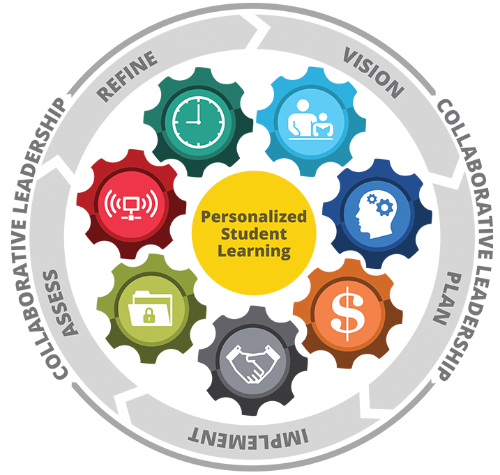
The Future Ready Framework
The FRS network is built on our research-based framework that emphasizes collaborative leadership and creating an innovative school culture to ensure student-centered learning. The framework focuses on seven key areas (called gears), plus collaborative leadership.
In addition to our foundational framework, we provide individual role-based frameworks leadership to help educators with setting professional growth goals and providing ways to leverage FRS resources, strategies, and action planning for professional transformation.

This guide is generously supported by GoGuardian, Pear Deck, and Edulastic.